

Nonviolence is not easy

Preface: I started writing this three weeks ago, right after the last assassination attempt on the president at the White House Correspondents’ Dinner. I had a hard time finishing it, and, due to the topic, I didn’t want to rush it. I still don’t feel completely satisfied, but I decided to publish it in order to be able to move on. It’s so strange to me that the catalyst event for this piece seems so long ago now. Violence, whether it is a mass shooting or an act of political violence, is, sadly, just a part of our fabric in America now. I think I’m trying to dig towards something I don’t quite get to completely in this post, but I think I get closest when I explore how political violence is a feature, not a bug, in the American experience and narrative. Until we face this and challenge the premise that America has historically and continues to be, by default, a force for peace and goodwill, I don’t believe we will ever find healing. But these are just my observations. I offer the following with the caveat that I’m daily working this stuff out, so I ask for mercy.
Nonviolence is not easy.
Whatever one thinks about the details surrounding the recent assassination attempt on the president and administration officials, one thing we do know is that there was expressed intent by the man who was apprehended by the Secret Service to take human life. In the so-called “manifesto” from the would-be assassin, moral justification was presented and framed in a moral and “Christian” context.
I refuse to quote or platform any more than necessary words from the man who planned and began to carry out an act that would have resulted in multiple deaths. However, for the sake of this post, I will note a central argument he posed: for a Christian, there is a difference between resisting oppression or violence targeted at oneself versus when it is targeted at another person.
I don’t believe taking human life is ever a righteous act.
However, it’s insincere to act as if taking this position doesn’t pose a serious conundrum. Without a heavy dose of fear and trembling, commitment to nonviolence is naive sloganeering at best or privileged detachment at worst. It’s easy to proclaim commitment to nonviolence from a place where violence isn’t imminent at your or your neighbor’s doorstep.
I read the examples from the manifesto of the man accused of trying to assassinate the president, and others - the proposed proof of justification - the Venezuelan fishermen executed, the Iranian schoolkids blown up, and the persons raped in the detention center - and I share the moral outrage and a part of the sentiment that someone needs to stand in the way, that the time for relying on conventional political methods is over. I certainly don’t trust the opposition party, as it stands now, to do anything meaningful to stand against a regime that has proven to be bent on eroding civil rights, demonizing and harming immigrants, brazenly disregarding international law, norms, and alliances, and launching a murderous war of aggression alongside a sole ally that is actively committing genocide in Gaza and now expanding into Lebanon.
So I understand those who call for resistance with more teeth than another No Kings rally, late-night monologues, or appellate court orders and restrictions on authoritarian moves (although this last one at least has produced real results). When I come home from an ICE detention visit, I am often exhausted, despondent, and, yes, very angry. When I hear stories of people denied medical help, held in unsafe conditions, subjected to the obscenely expensive and complex processes of an immigration and incarceration (even though it’s called detention… it’s incarceration) system designed not for justice but punishment and often profit, it’s pretty hard to want to stay nuanced or “understand both sides” or wait for meaningful, gradual reform.
I want those detention centers closed now. I want ICE abolished. I want those responsible for this to face consequences for what they are doing to persons, families, and communities.
Yes, I want comprehensive immigration reform yesterday. But the harm and terrorization of human beings while we wait for Congress to do its job is unacceptable and of primary, not secondary, concern.
After the reported death of a detainee in the Miami Correctional Facility, the ICE website posted an official report. It led with a litany of the man’s previous criminal record. Crimes, by the way, for which he had done his time. Crimes which were irrelevant to the actual incident at hand - a person died in ICE custody. The purpose of the public report was clear: to present the deceased in light of his past to lessen his humanity, lessen the scandal of his death in detention, lessen the responsibility of ICE and the State of Indiana, and lessen our collective responsibility. It also perpetuates the narrative that the Trump administration was truly “getting the worst of the worst off the streets.”
I mean, maybe some of them will die, but at least they are not in my neighborhood.
It might just have to get tougher before it gets better, but at least Trump is doing something about it.
Some of those people are murderers, the worst of the worst. Sometimes, you have to have the courage to do the hard thing to stop a worse thing.
See how the line of argument goes?
This is all symptomatic of a nation with a deeply seared conscience. I am beyond exhausted with the argument that “both sides do this,” because, even if this is so (and we could point to issues like Gaza and even immigration as examples of bipartisan failure), I find it simply keeps the cycle of inaction or moral stance paralyzed. It perpetuates the resigned conclusion “there’s nothing we can do about it.” But while I’m tired of it rhetorically, I understand it and do think it helps explain the desperation or resignation many feel, which sometimes leads to desperate actions. Injustice compounded with a sense of powerlessness is a profoundly combustible combination.
But I don’t believe taking a human life is ever righteous. Further, I believe that the increase of political violence and its justification (see this poll from last September) is also a symptom of a nation with a deeply seared conscience.
We know we’re not ok.
MAGA attempted to address this existential unease with a combination of a manufactured outsider stance (Donald Trump and many in his circle are absolutely part of the elite class) and a promise to fight for those who felt left behind by the system through disruption and retribution. It also provided plenty of targets, enemies to blame for why things were not ok - democrats, the media, academia, “woke,” transgender people, and, of course, immigrants with brown skin from “shithole” countries. The strategy has historic precedence, but it’s also a very American tactic, politically.
Political violence is also very American. We are a nation born in revolution, in political violence against tyranny. I’ve seen “1776” and “Don’t Tread On Me” slogans embraced by people on either side of the political spectrum, depending on who is in office. Both of those imply that one may have to take up arms against an oppressor if things get too off track. Our national mythology is shot through with the righteous vigilante who takes a stand outside the system’s rules, or even the law, to bring justice. And that vigilante has a gun and uses it. Nothing is healed in this, just the need for another vigilante with another gun to continue the ritual.
Within the sole criteria of the American narrative, violent resistance to state overreach or tyranny is not only justified but, arguably, woven into the fabric of our origin story. Of course, the problem we have now is that our nation is polarized over what state overreach or tyranny means. I heard for years, in my hometown, justification for stockpiling weapons in fear that Clinton, Obama, or Biden (but especially Obama) was scheming to confiscate guns and initiate a socialist hellscape. I also watched the political violence of January 6th happen, and the justification for it, even among Christians and Christian clergy.
But now I hear justification for political violence in the other direction, including among Christians and Christian clergy. The would-be assassin at the White House Correspondence Dinner used Christian language, but it was still framed in a context I am hard-pressed to actually find in the Gospel. This may be precisely where the Gospel shows itself as foolish, once again, in the face of the crisis of injustice and human cruelty.
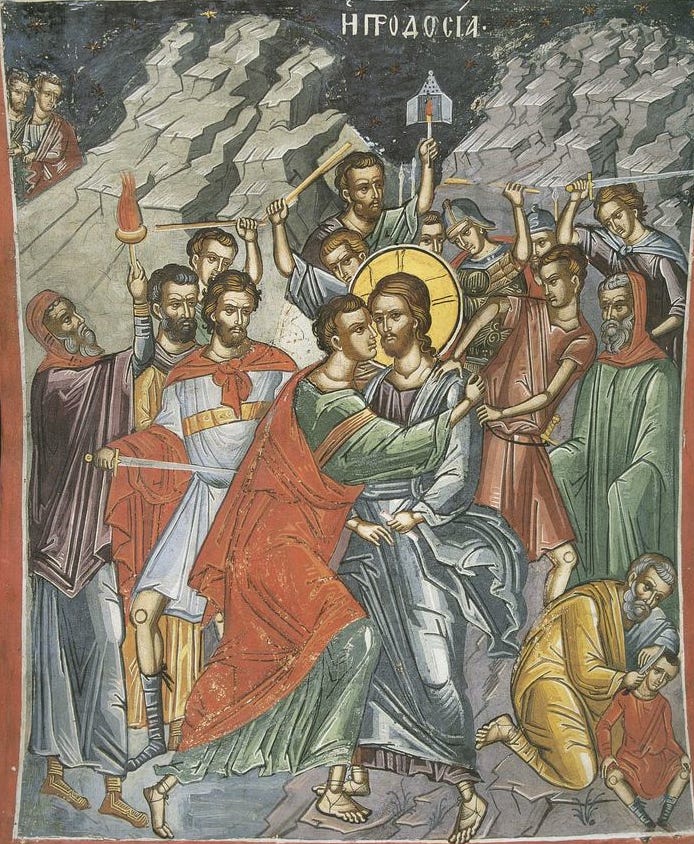
Then the men stepped forward, seized Jesus and arrested him. With that, one of Jesus’ companions reached for his sword, drew it out and struck the servant of the high priest, cutting off his ear. “Put your sword back in its place,” Jesus said to him, “for all who draw the sword will die by the sword. Do you think I cannot call on my Father, and he will at once put at my disposal more than twelve legions of angels? (Matthew 26:51-53).
I cannot claim to follow Jesus and come to any other conclusion: taking human life or even doing violence to a human is never righteous. If I believe the invocation of God to bless bombs and bullets for the empire I sojourn in is blasphemous, I must believe that responding to the oppressor with violence is not justified. But I also do not believe that silence or lack of courage in the face of oppression and state violence is justified. We are living in a time when people who follow Jesus must stand, with courage, against the narrative that God is somehow on the side of dehumanization, cruelty, or revenge.
But this comes with a cost. It requires real sacrifice, real willingness to stand in the way of those who oppress, dehumanize, and do violence, and to call out, directly and unequivocally, that using God’s name to justify violence or dehumanization is blasphemy. We need moral leadership right now with the courage to hear the voices of those who are suffering the most, but also to listen to those who have lost any trust or hope in the usual forms of resistance and opposition against what they see as an existential emergency. Political violence will win the day if no alternative offers a courageous response without violence.
There are examples of organized, nonviolent resistance happening, from mutual aid collectives helping provide assistance and transportation to at-risk immigrants or those who have been detained and their families. There are protest movements like Rev. William Barber’s Poor People’s Campaign speaking head-on with moral clarity and vision against injustice, and even getting arrested sometimes for it. There are economic actions - in Minneapolis, mass actions were taken to boycott and publicize businesses that assisted ICE. There are numerous actions all over the country, but they are often local, not slogan-driven, and, most essentially, require skin in the game beyond a hashtag or lawn sign. True nonviolent action demands this.
Palestinian author, poet, and activist Rasha Abdulhadi uses the image of throwing sand in the cogs of the machine, no matter how little you feel you have to give. Addressing the genocide in Gaza, which certainly stands among the most egregious and naked examples of violent injustice, Abdulhadi bids people with a conscience:
Whatever sand you can throw on the gears of genocide, do it now. If it's a handful, throw it. If it's a fingernail full, scrape it out and throw. Get in the way however you can. We must mobilize our righteous bodies and hearts by the millions and stand tall now!
To conclude, some words from Rev. William Barber:
We must stand tall because bowing down is not an option. It may take mass nonviolent sit-ins in the halls of Congress or nonviolent civil disobedience. If they arrest us, so be it. But we must stand tall. It may take mass pray-ins, but stand tall. It may take a labor strike day on Election Day so that all working people can vote, but stand tall! It may take mass counter lawsuits, but stand tall!
Standing tall, throwing sand in the gears is not only the response this moment calls for. Nonviolent resistance is not easy, but the alternative response to injustice that can no longer stand will involve violence, and the continuation of the destructive cycle we are in.
Woke up this morning with these words from your song in my head:
“The arc is long but bends on the side of justice, but I’m tired of waiting/Peace isn’t passive and love is a hard working engine, good good trouble, a rock in the sand”
Then I read this piece you wrote, felt that “tired of waiting,” then realized however strong this lyric is, the most powerful to me might be “peace isn’t passive and love is a hard working engine.”
Then the lines from the Thanksgiving prayer we say after Eucharist in the Episcopal Church came to mind: “Send us out to do the work you have given us to do, to love and serve you as faithful witnesses. . .”
An interesting convergence of memory and your writing!
But it made me think that being a “faithful witness” is being part of that “hard-working engine” and being part of that engine is being a faithful witness, going where the hurt is, telling the story and not letting victims of cruelty be dehumanized. And also sharing ways of thinking through all of this. I am grateful that you do all of this.